Why I built it
I live in the Midwest. Black bears show up here occasionally, but I'd never seen one close by until a few weeks ago, when one wandered through our yard (my husband saw it; I missed it). I have family in Montana and have hiked a lot of bear country in Montana and Wyoming. My closest encounters, though, came on my first and only trip to Alaska earlier this year. I learned a lot about coastal brown bears there, and in Katmai National Park I watched how (relatively!) docile they can be.
Meanwhile, a friend who grew up in Montana has a serious fear of bears after a childhood of news stories about maulings and deaths. To them, every walk in the park was a possible bear encounter.
What actually put the idea in my head was two books. First I read Bill Bryson's A Walk in the Woods, about walking the Appalachian Trail in the 90s. Part of his preparation was reading Stephen Herrero's Bear Attacks: Their Causes and Avoidance, so of course I read that next.
I was blown away by how research- and data-driven Herrero's work is. The book has plenty of real stories, from brutal grizzly maulings at campsites to black bears dragging children off back porches. But it also teaches you the many factors behind every encounter. Experts give a standard list of precautions, behaviors and deterrents for bear country. Herrero uses a century of data to explain why they're recommended, and why encounters that look almost identical can still end very differently.
The first thing I asked myself after finishing it was: “Would I actually remember any of this if a bear were in front of me?”
Would I remember not to run? To stand my ground, protect my neck, or fight back, and which one applies when? That's where the simulator came from. I wanted something that teaches people how to handle an encounter, and also takes away some of the fear that we're all one moment from a brutal attack the second we step onto a trail.
What it does
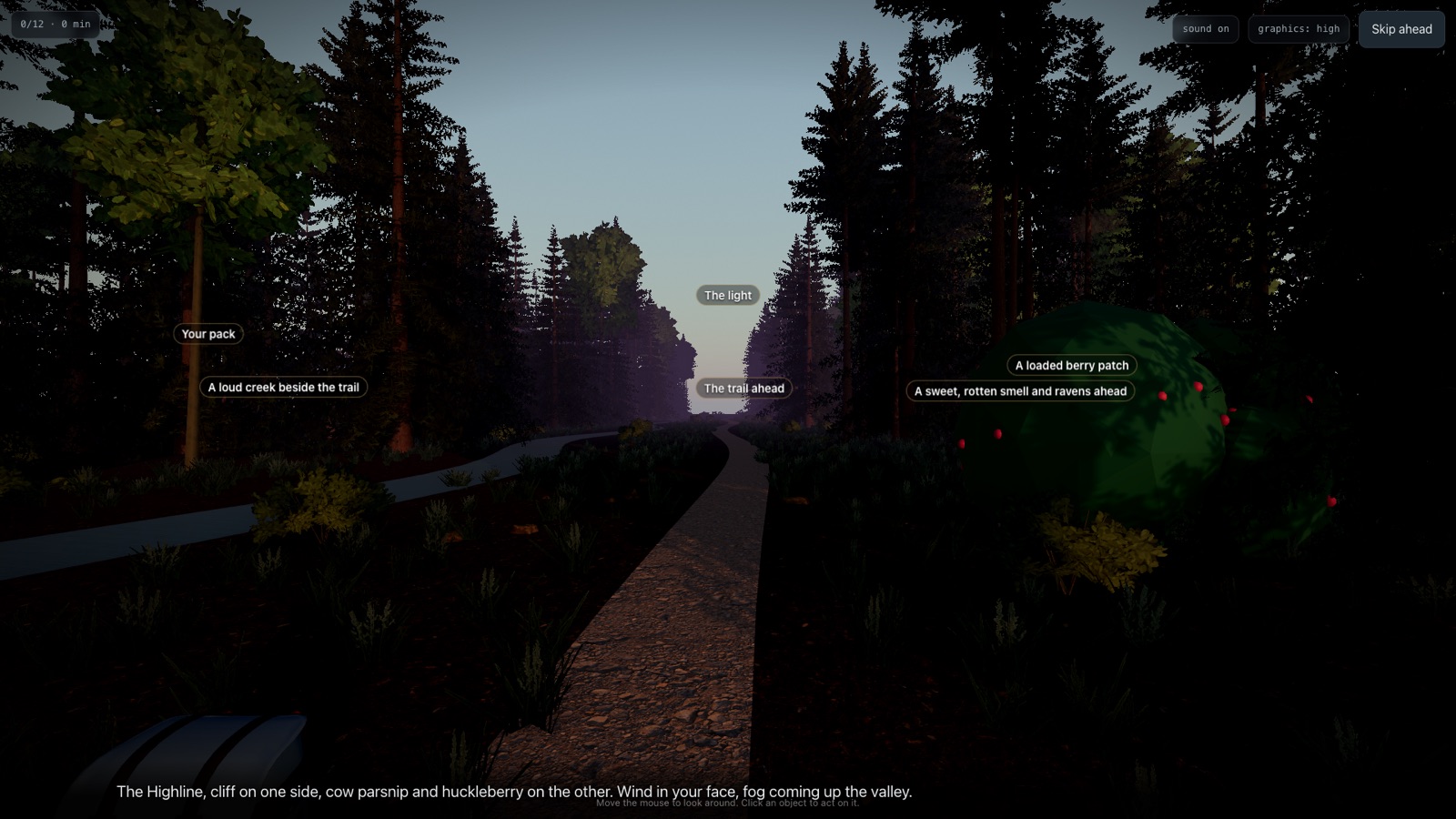
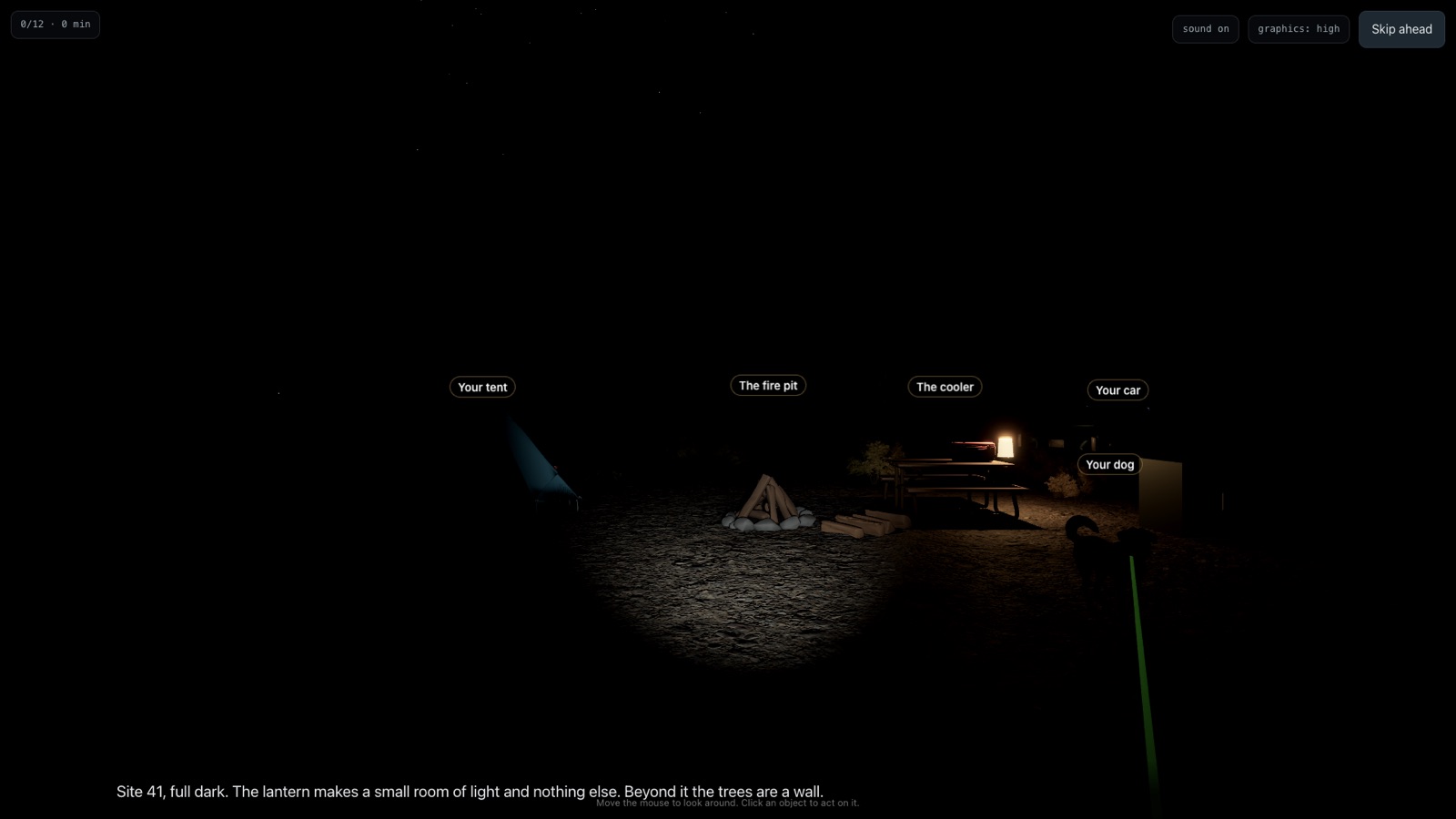
- Real places and situations. 11 locations, including Great Smoky Mountains, Glacier, Banff, Yellowstone, Katmai, Denali and Jasper, across 7 settings: day trail, backcountry camp, campsite, vacation rental, fishing stream, berry patch and trailhead.
- Conditions matter. Season, time of day and how prepared you are change what you're carrying and which bears you're likely to meet.
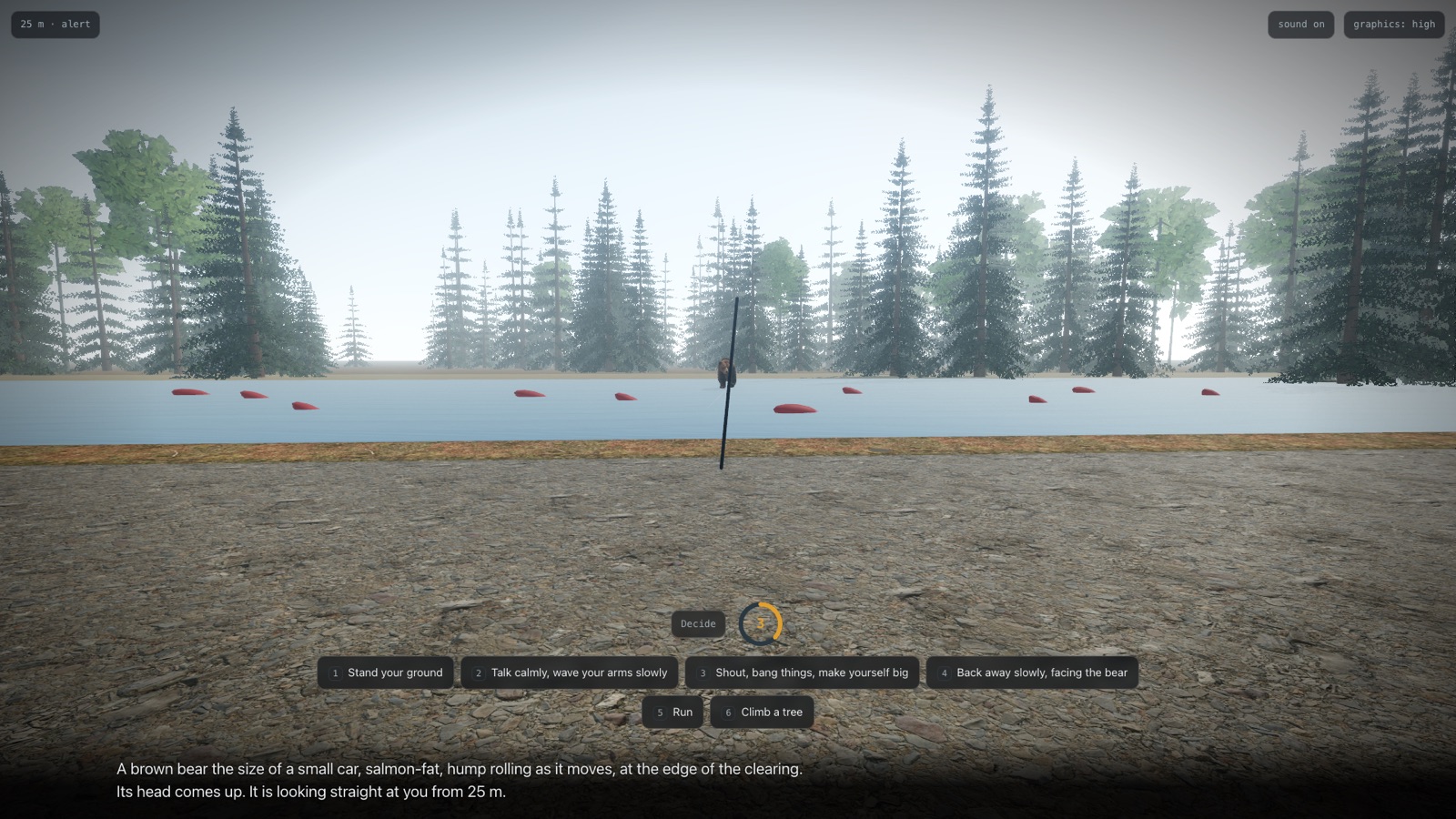
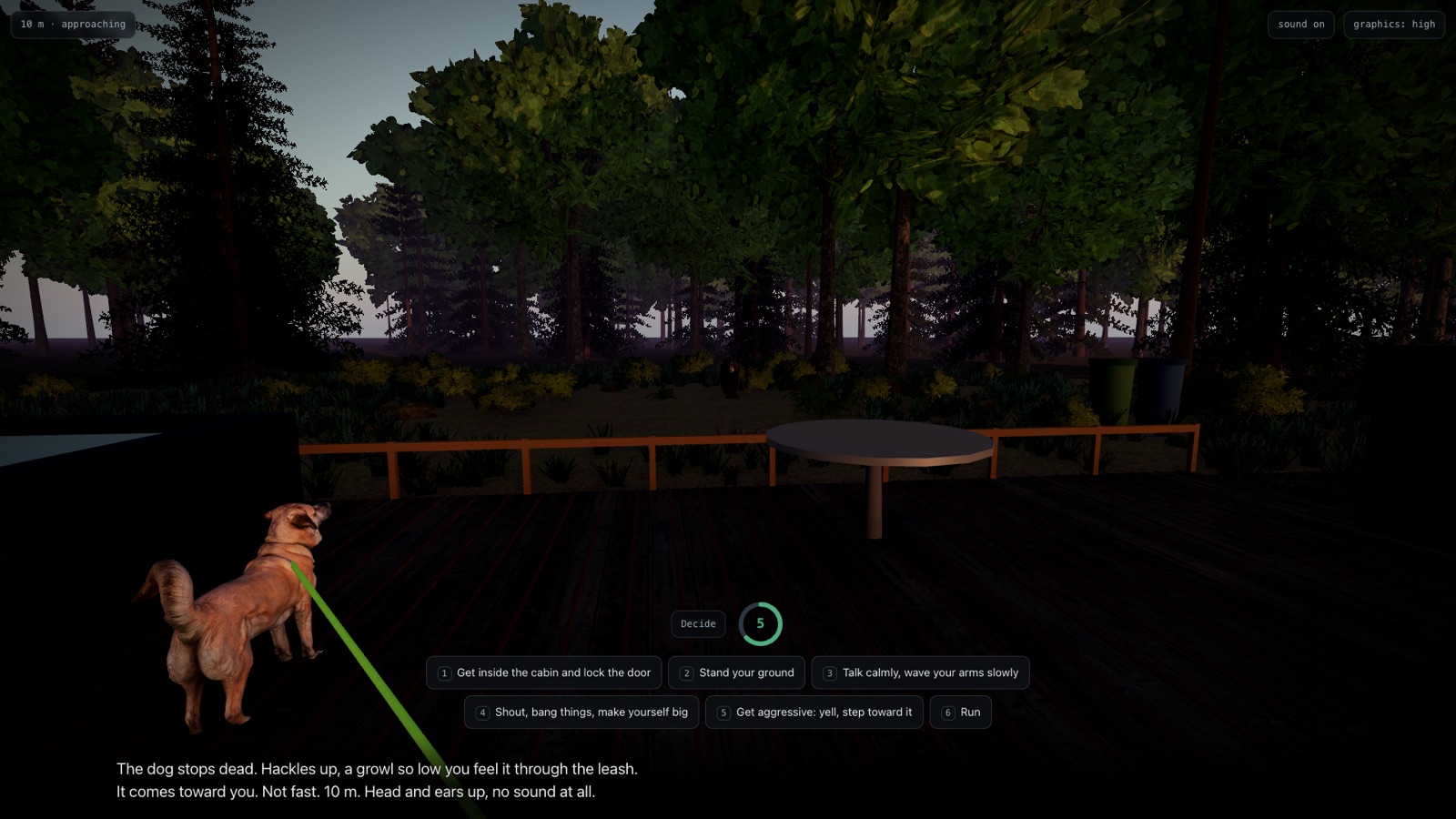
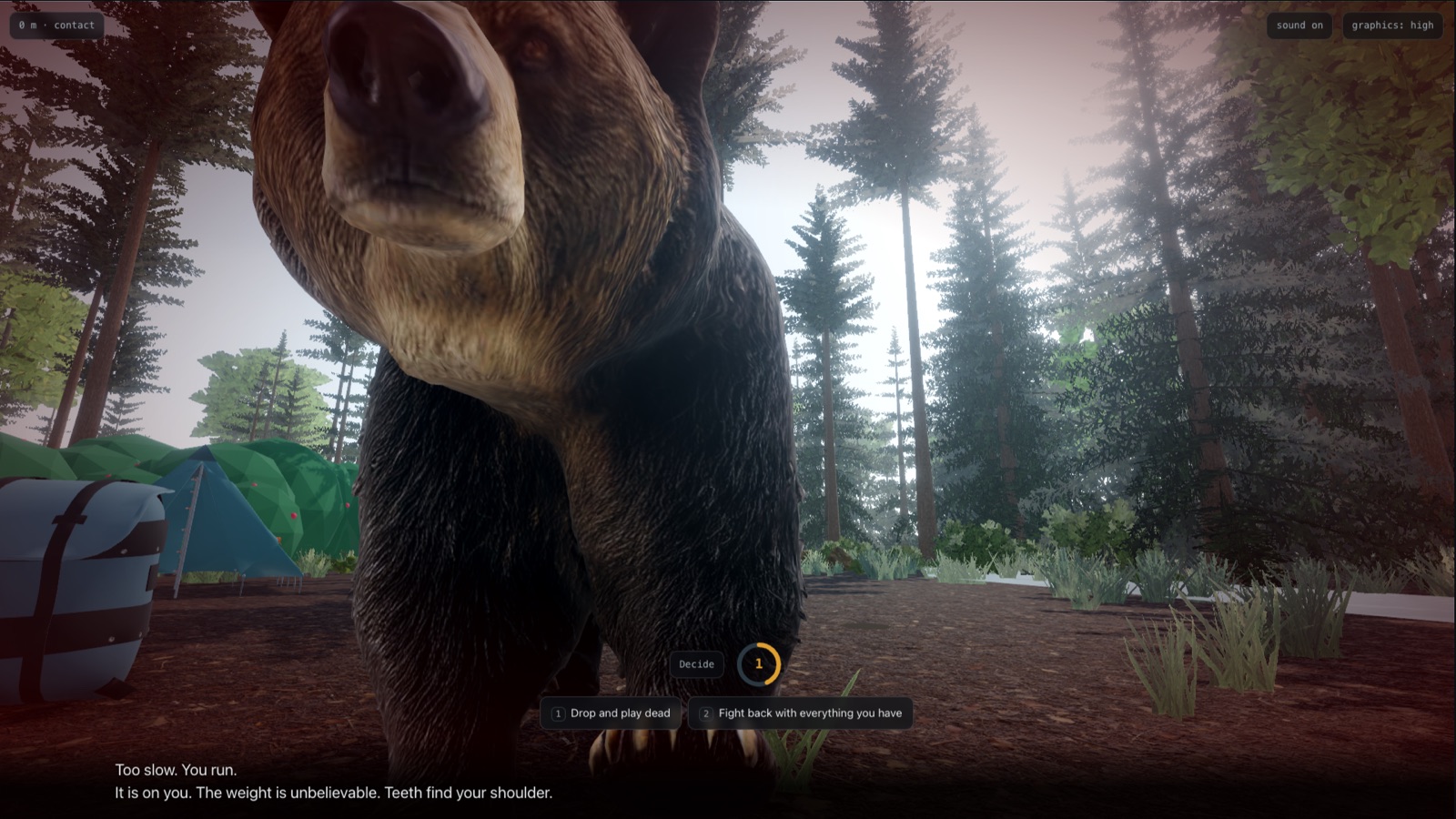
- Explore, then decide under pressure. In a first-person 3D exploration phase, your choices (food left out, noise, the dog) quietly change the odds. Then comes a real-time encounter with a countdown and up to 21 possible actions: stand your ground, back away, bear spray, play dead, fight back, climb, run…
- Four honest outcomes: no injury, minor, serious or fatal.
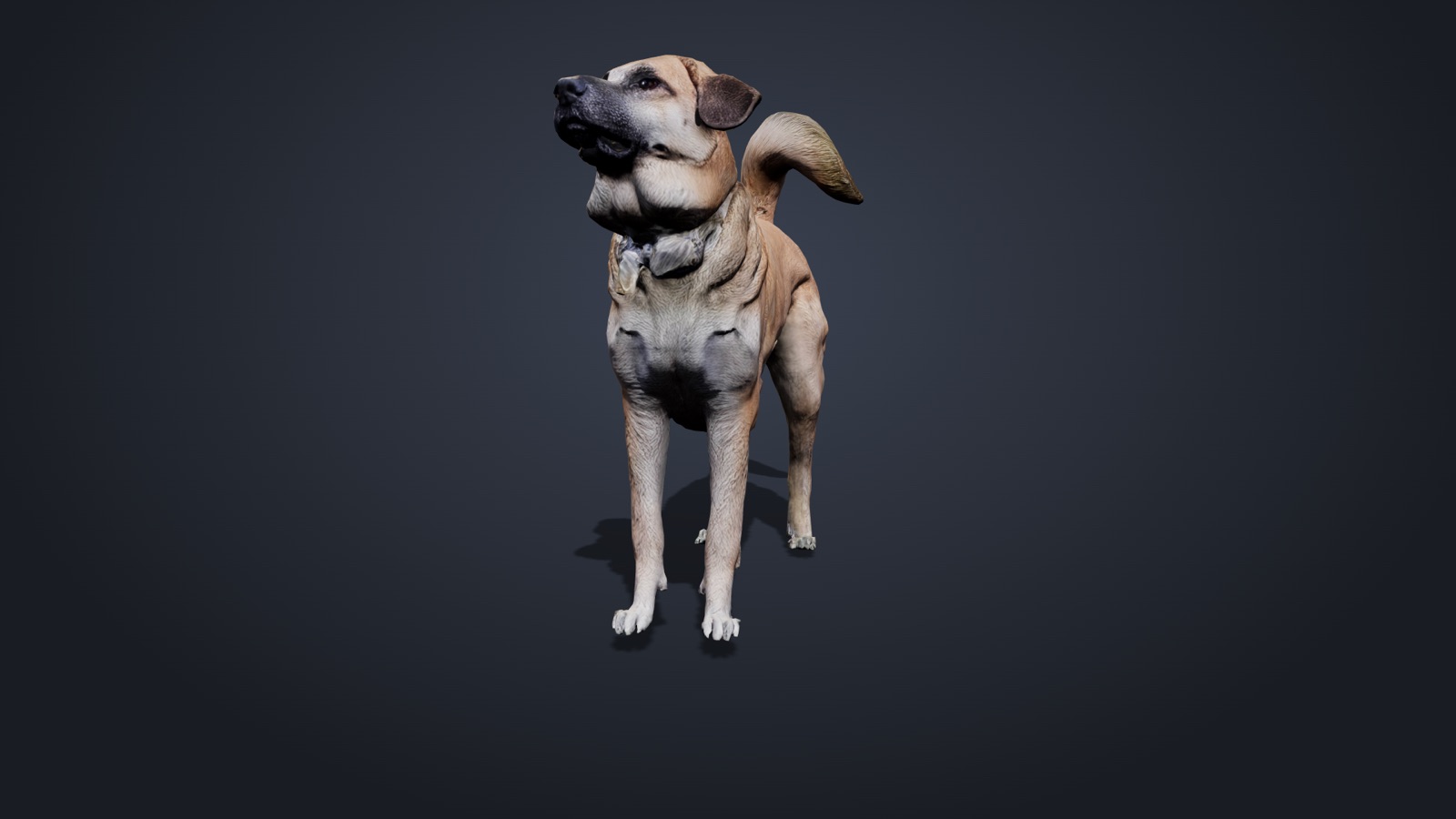
- An optional dog, modeled on my own, which can make things much worse, exactly as wildlife agencies warn.
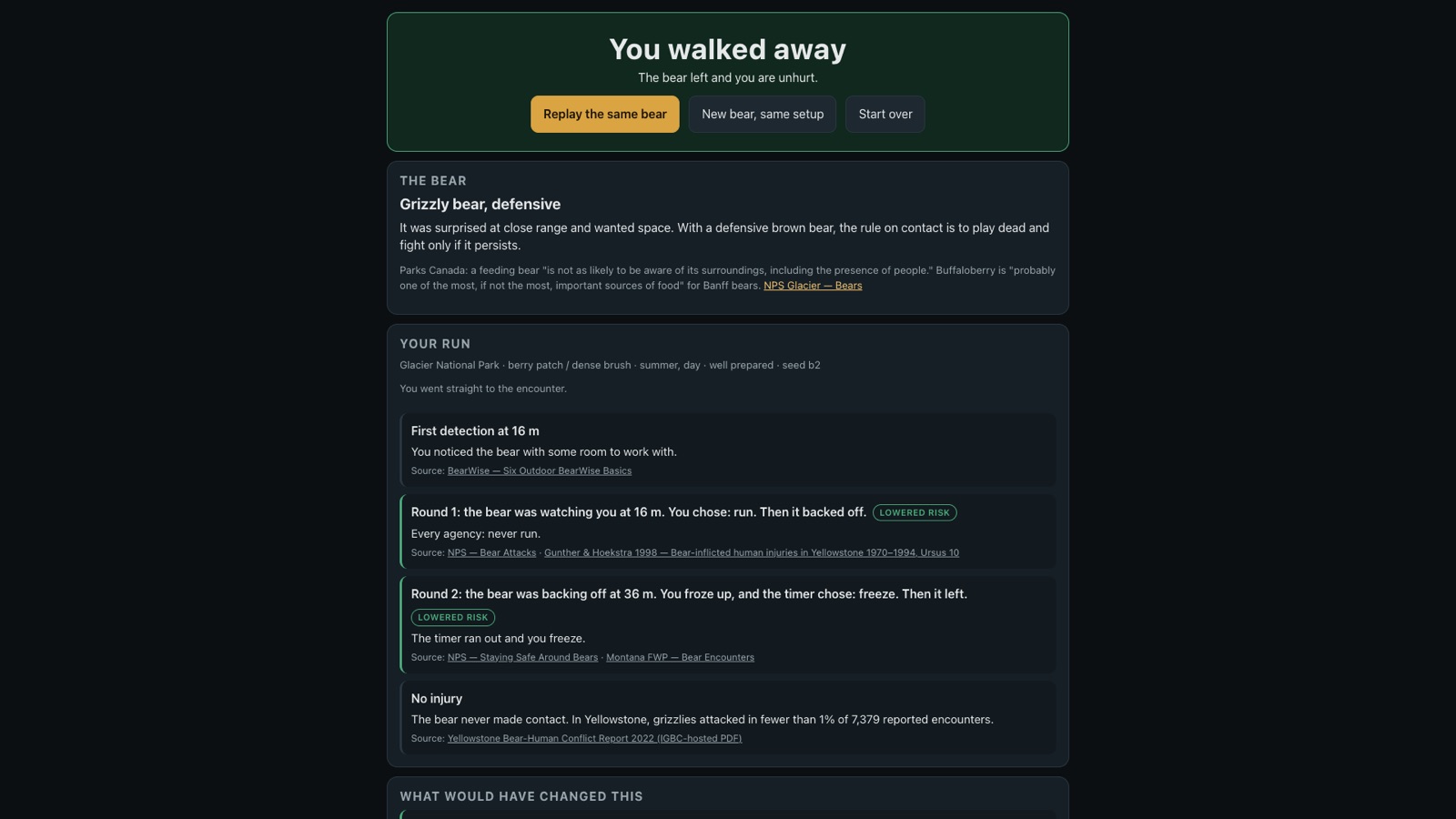
- A calm debrief afterwards that walks through every factor that shaped your outcome, with citations.
Screenshots
How it's built
The one rule: no unsourced claims
The project's instructions to Claude say that every behavior, statistic and probability weight has to trace back to a verifiable source. Claude researched and built a registry of sources from the National Park Service, BearWise, Parks Canada, state wildlife agencies and peer-reviewed research. Every data record carries its sources and a confidence level, and the low-confidence ones are labelled as such in the debrief.
Where agencies disagree (play dead vs fight back with a defensive black bear, or spraying at 20 ft vs 60 ft), the simulator keeps the disagreement and explains it instead of quietly picking a side. That felt very much in the spirit of Herrero.
Stack
- TypeScript, React, Vite and Zustand, with 3D in react-three-fiber / Three.js; hosted on Vercel.
- A seeded, deterministic simulation engine that is separate from the UI. Every decision that affects the outcome is written to a “factor ledger”, and the debrief is generated only from that ledger.
- Monte Carlo tests that check orderings rather than exact numbers. For example, running from a grizzly must be riskier than standing your ground, so the weights can be tuned without breaking the tests.
- A command-line tool that plays thousands of encounters per scenario, so the probabilities can be sanity-checked against the research before anything reaches the screen.
Where Claude fits in
- Claude Code wrote nearly all of it, in phases: research, then a design doc, the engine and tests, the UI, and finally 3D. I reviewed at each milestone.
- Claude as narrator (optional). It writes short, tense first-person narration, but it may only describe what the engine already decided. It never chooses what the bear does, and the game is fully playable without it.
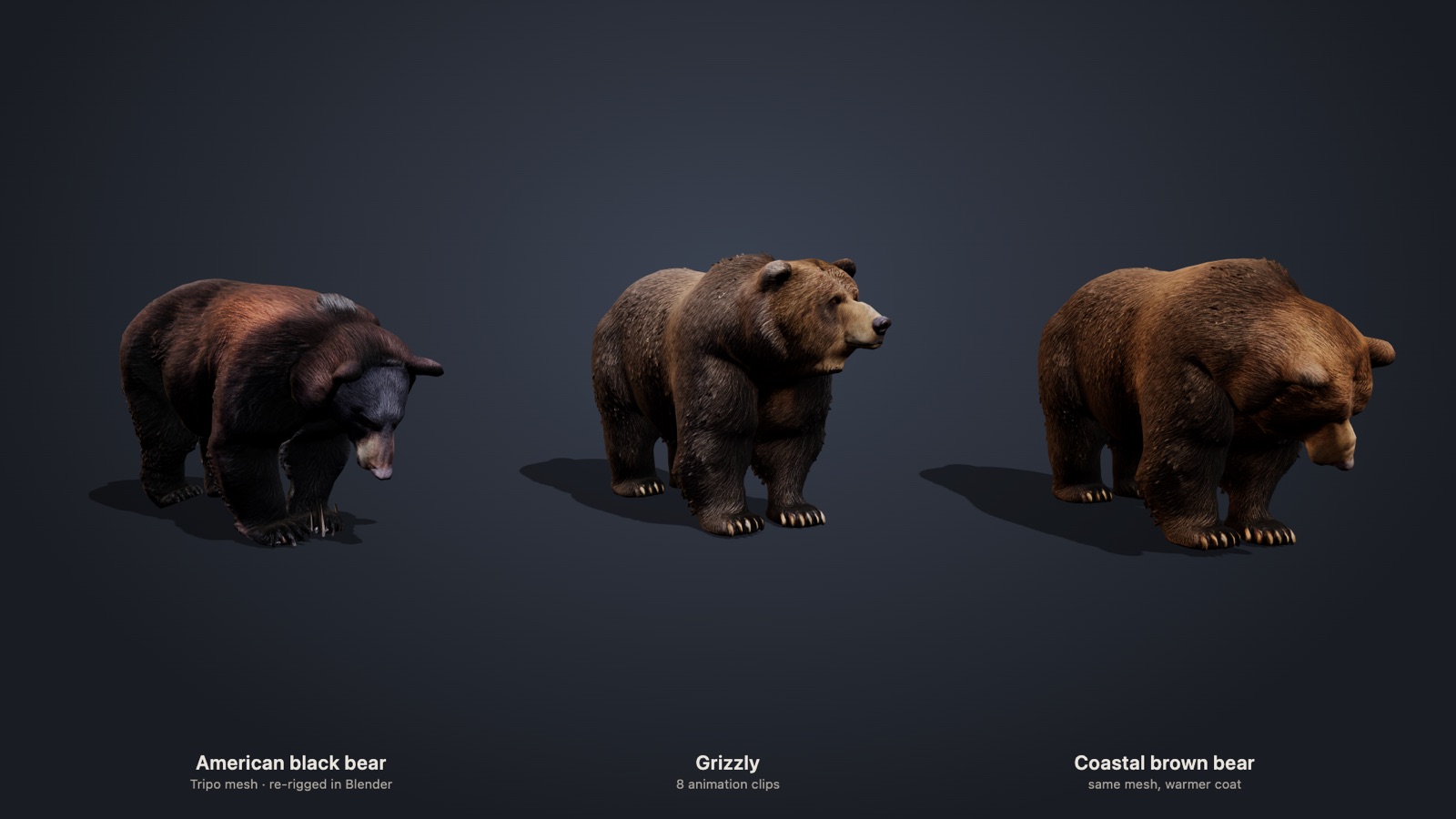
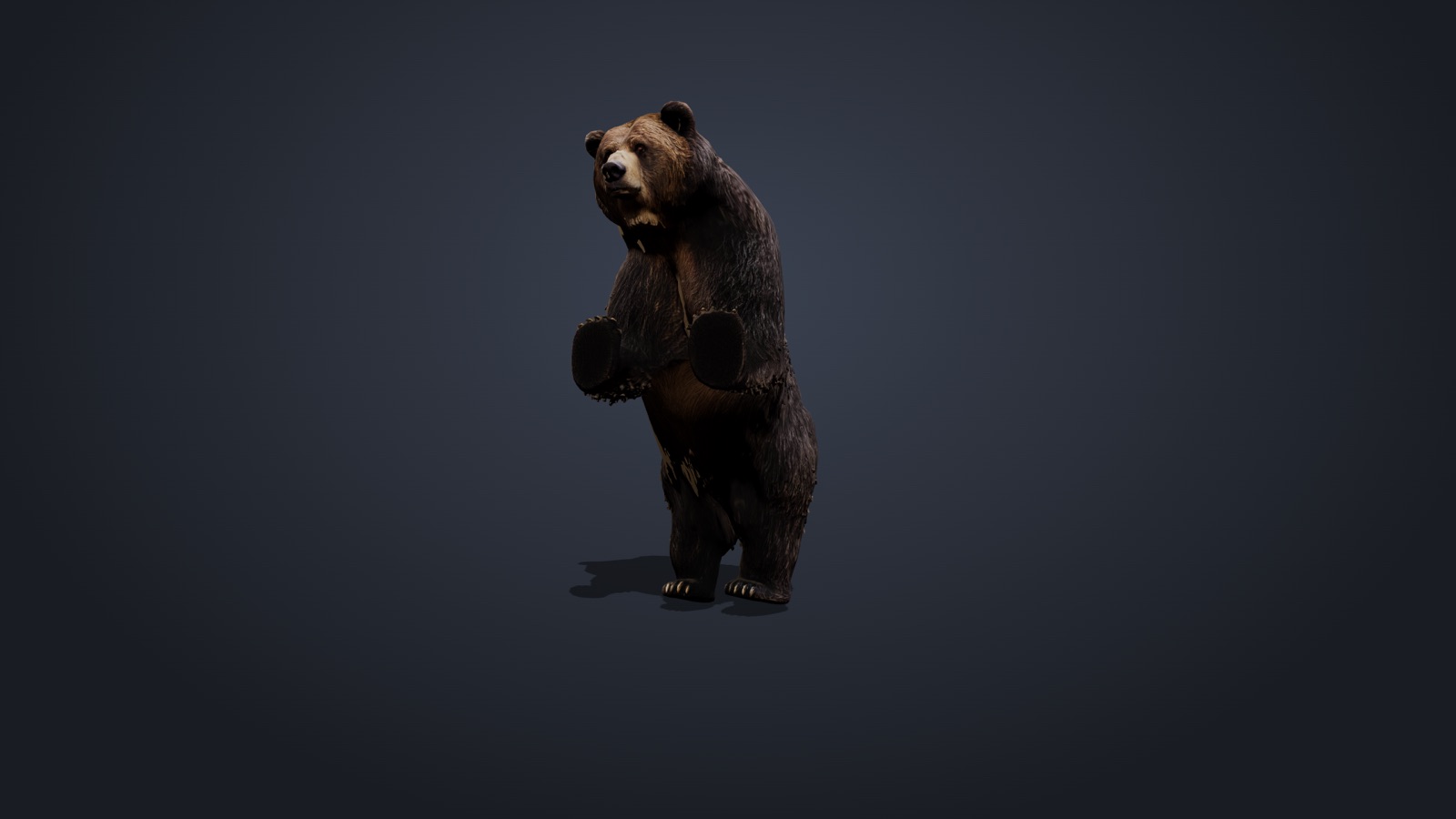
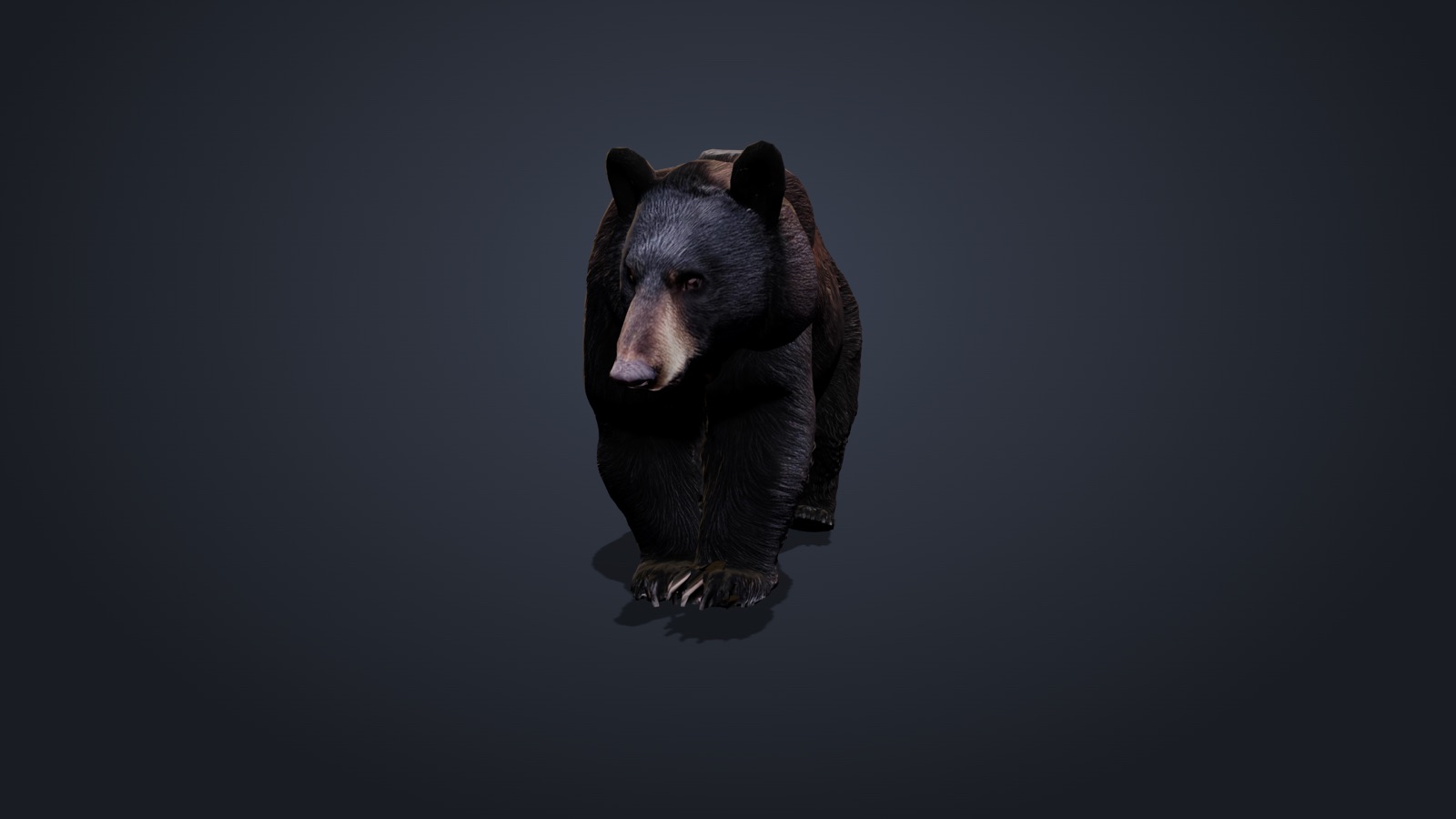
- 3D models. I generated the bears and my dog in Tripo. Claude used the Blender MCP to re-rig them onto a shared skeleton, build their animations and optimize them for the web.
- Environments use free (CC0) photoscanned ground and bark from Poly Haven and props from Adobe Substance 3D Assets.
Still a work in progress
Next on my list:
- 3D environments modeled on the actual locations, like Brooks River in Katmai and Glacier's Highline Trail, instead of generic forest.
- Real player movement through the scene.
- “Gamifying” it, with two modes: the realistic educational simulator it is today, and a deliberately unrealistic horror game. I have a lot of ideas there, some going well beyond bears.
About me
I'm a Power BI report developer. I've watched Claude become genuinely useful in my day job, and a couple of months ago I started building my own projects with it.
My other project is Bullsheet.app, which runs leagues, tracks team and player stats, and runs tournaments. I'm always happy to talk about either one.